What to Expect at Jigokudani Monkey Park
Entry fees, opening hours, the 1.6 km walk, what to wear and how close you actually get. The practical detail the tour listings leave out.
Jigokudani is not a zoo and it is not a viewing platform. It is a hot spring at the head of a narrow gorge, reached by a mile-long footpath, where a wild troop of Japanese macaques comes down to bathe because the water is warmer than the air. Knowing the shape of the place before you arrive changes what you wear, when you go and how disappointed you are if the pool is empty.
Check Availability
Tickets and opening hours
Admission is ¥800 for adults and ¥400 for school-age children. From 1 December 2026 that rises to ¥1,000 and ¥500 at the gate, with e-tickets bought online at ¥880 and ¥440. Children under six are free.
Almost no tour from Tokyo includes it. Of the eight we compare, only the Nagano-based one has the fee in the fare. Everyone else pays at the gate, and the gate takes cash in yen — bring it with you, because there is nothing at the trailhead.
Opening hours are seasonal:
| Season | Hours |
|---|---|
| April to October | 08:30 – 17:00 |
| November to March | 09:00 – 16:00 |
The park is open every day of the year. On busy winter weekends and holidays admission can be limited to visitors holding e-tickets, which can be bought up to three months in advance for a specific date. If you are going independently on a January Saturday, buy one.
The walk in
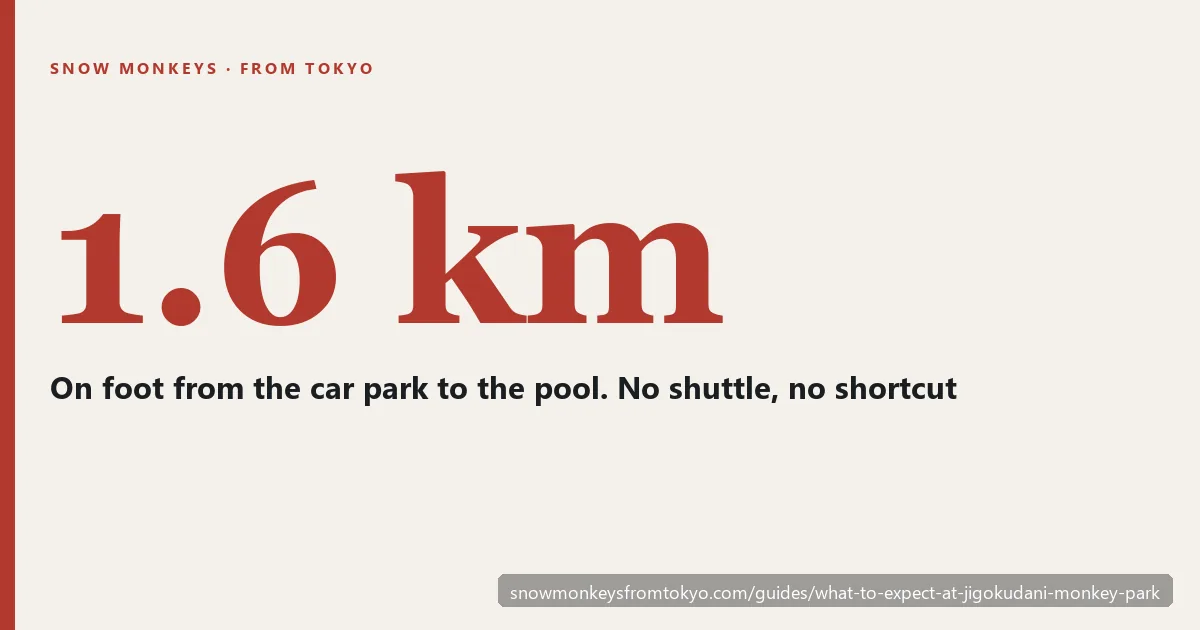
This is the part that catches people out. No vehicle reaches the park. Cars and buses stop at Kanbayashi Onsen, and the last 1.6 km — a mile — is on foot.
The trail follows the Yokoyu river through cedar forest. It is mostly level, wide enough to pass comfortably, and takes twenty-five to thirty minutes at an ordinary pace. In summer it is a pleasant woodland walk. From November to March it is compacted snow and ice, and it is genuinely slippery — not treacherous, but not something to attempt in smooth-soled trainers.
Crampons are sold at the trailhead for a few hundred yen and are the best money you will spend that day. Pushchairs cannot be used. There is no shuttle, no taxi and no shortcut, and the walk is the same length going back when your legs are tired and the light is going.
What to wear
Boots with grip, first and last. Everything else is ordinary mountain-weather sense:
- Footwear: waterproof boots with a lugged sole. This matters more than your coat.
- Layers: the valley is cold and the walk is warm. You will want to shed a layer on the way in and put it back on standing at the pool.
- Gloves and a hat in winter. You will be standing still, taking photographs, for an hour.
- A dry bag or a lens cloth. Steam off the pool condenses on everything, and cameras fog the moment you lean over the water.
- Cash in yen for the gate.
At the pool
There is no glass, no barrier and no enclosure. The path runs within a few feet of the water and the macaques walk it alongside you. The park’s rules are short and sensible: do not touch them, do not feed them, do not stare directly into their eyes, and do not bring food out of your bag where they can see it.
The troop comes and goes on its own schedule. Park staff put out barley, soybeans and apples each day — the practice that has kept the monkeys in the valley since the park was founded in 1964, rather than raiding the farms below — so there is usually a group present in daylight hours. Whether they are in the water is a different question, and it depends almost entirely on how cold the morning is.
Numbers tend to build through the late morning and thin out by mid-afternoon. On a January morning you might find thirty animals in and around the pool. On a warm September afternoon you might find the pool empty and a dozen monkeys asleep on the rocks, which is still a fine thing to see and not what you came for. Our month-by-month guide sets out which is which.
How long to allow
Thirty minutes each way on the trail, plus however long you want at the pool. An hour at the water is enough to watch the troop properly; two is enough to stop taking photographs and start noticing behaviour — grooming lines, young animals swimming, the hierarchy around the warmest corner.
The tours from Tokyo allocate between one and two hours inside the park, and the difference is real. Our comparison lists what each one gives you, because it is not the number the listings lead with.
With children
The walk decides it. Most school-age children manage 1.6 km on an icy path without complaint; most toddlers do not, and a pushchair is not an option. One operator sets a minimum age of one year and excludes visitors over 150 kg; several others simply exclude anyone who cannot manage the trail unaided.
If you are travelling with very young children, the honest advice is that this is a long day for a short walk they cannot do — and a private charter, where the car is yours and the timetable is flexible, is the only version that bends around a nap.
Ready to fix a date? Compare the tours, or read how to get there if you are still choosing between the road and the rails.
See the Snow Monkeys — and Be Back in Tokyo by Evening
A private vehicle both ways, a 30-minute forest walk in, and unhurried time at the hot spring. Rated 4.9/5 by 218 guests. Free cancellation up to 24 hours before.
Check Availability & Book