Why Do Snow Monkeys Bathe in Hot Springs? The Science and the Story
Jigokudani's snow monkeys started bathing in 1963, in an inn's outdoor bath. What the science says, which monkeys get in, and when you're most likely to see it.
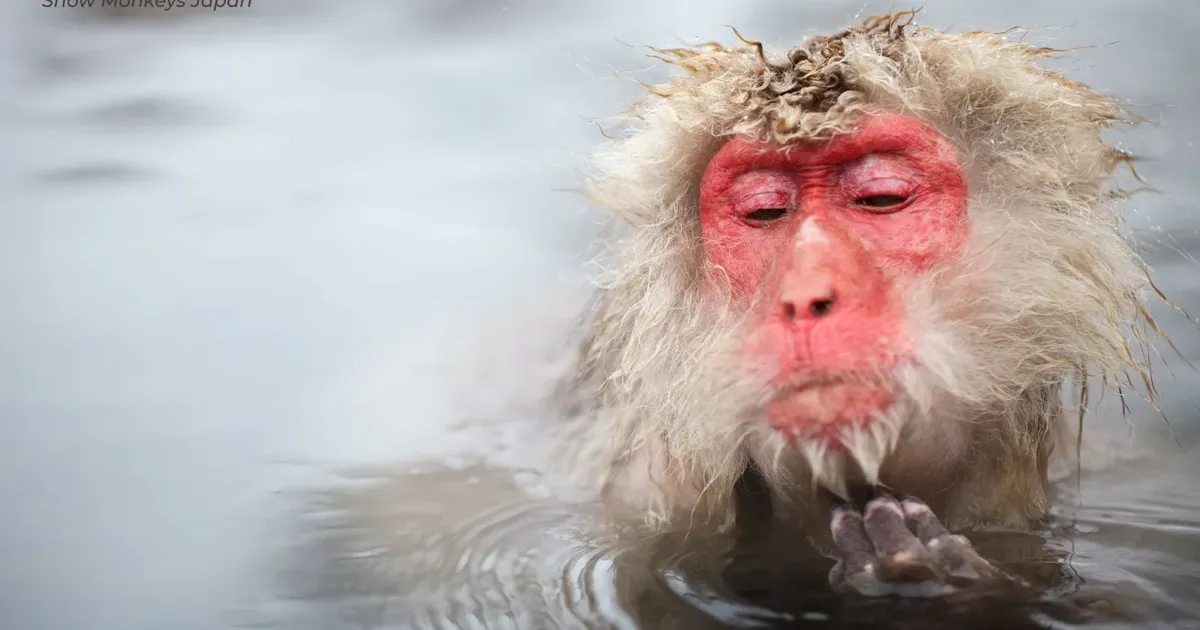
In January the air in Jigokudani, a steep, steaming gorge in northern Nagano, drops below −10°C. Snow settles on anything that keeps still. One of the things keeping still is a wild Japanese macaque, sitting chin-deep in a rock pool with her eyes half-closed and a little cap of frost on her head. It’s one of the most famous wildlife pictures in Japan, and most people assume the monkeys have always done this.
They haven’t. The habit began in the winter of 1962–63, a few months after people started feeding the troop. It began in a human bath at the inn next door, and even today only part of the troop takes part. The story involves a floating apple, three eyewitnesses who disagree, and 60 years of research that is still turning up surprises, including a 2026 study on lice and gut bacteria.
This guide covers why the monkeys bathe, how the habit started and spread, which monkeys get in, what the water is, and how to time your visit for the best odds of seeing it.
Quick answer
- Why: mainly to keep warm. Bathing rises in winter and on colder days, and the park says it is how the monkeys cope with Jigokudani’s winters below −10°C.
- Stress: a 2018 Kyoto University study of 12 adult females linked bathing to lower stress-hormone levels (Takeshita et al., Primates).
- Not instinct: it’s a learned habit. Young monkeys started it in the inn’s bath in winter 1962–63, after people began feeding the troop on 12 September 1962 (Matsuzawa 2018, Primates).
- Who: a minority. About 40 of roughly 160 monkeys (around 25%) bathed as of 2018, mostly adult females and juveniles.
- The pool: man-made (November 1967) and filled with natural hot water at about 40°C (Matsuzawa 2018).
- When to see it: the best odds are on cold, snowy days in January and February. Bathing is never guaranteed. (Checked 2 October 2026.)
Check Availability
Why do snow monkeys bathe in hot springs?
To stay warm. Bathing helps the monkeys save body heat in one of the coldest places any non-human primate lives, and it appears to lower their stress levels too.
Japanese macaques (Macaca fuscata) are the most northerly non-human primate on Earth. You can read about their biology in our snow monkey facts guide. Most troops get through winter with thick coats, huddling and shelter in the trees. The Jigokudani troop has an extra option: hot water within reach. The park puts it plainly: bathing is “wisdom” the monkeys acquired to get through Jigokudani’s severe winter cold, which falls below −10°C.
The evidence for the warmth explanation comes from several directions:
- Seasons. Zhang, Watanabe and Tokida (2007, American Journal of Primatology) followed the Jigokudani troop with regular scan sampling. They found that bathing increases in winter and concluded that thermoregulation is the main driver.
- Cold weeks. Takeshita and colleagues (2018) found adult females bathed more in winter than in spring, and most of all in the coldest weeks.
- The park’s own observations. The official site says the monkeys are “reluctant” to bathe in warm weather, while on very cold days many bathe and some stay in “for a couple of hours”.
The park also names three conditions that made the habit possible. Feeding gave the monkeys spare time, Jigokudani is very cold, and there were hot-spring baths on site. Put simply, bathing started as a side effect of people feeding a troop next to an inn bath. The monkeys turned it into a way of coping with winter.
Fact box: do the monkeys bathe to get clean? No. The park says the monkeys don’t wash in the bath. They soak because it feels good to warm up. The 2026 study below found changes in where lice live on a bather’s body, which is not the same as getting clean.
Does bathing lower their stress?
Yes, according to the one study that measured it, though it has limits. Rafaela Takeshita, Fred Bercovitch, Kodzue Kinoshita and Michael Huffman of Kyoto University studied 12 adult females at Jigokudani. The study appeared in Primates in April 2018. They compared two periods, the spring birth season (April–June) and the winter mating season (October–December), and measured breakdown products of stress hormones (glucocorticoids) in the monkeys’ dung.
What they found:
- More bathing when it’s cold. Females bathed more in winter, especially in colder weeks.
- Lower stress hormones. Bathing was associated with lower glucocorticoid levels. “As in humans, the hot spring has a stress-reducing effect in snow monkeys,” Takeshita said in the university’s release.
- Rank cuts both ways. There is one pool, and dominant females get priority access to it. They also had higher stress hormones overall, which the authors link to more aggression in winter. The pool gave them a benefit, but holding on to it had a social cost.
- Tourists didn’t register. About 500 visitors a day watched the monkeys during the study, and they had no measurable effect on the monkeys’ stress hormones.
Keep in mind:
- The sample was small: 12 animals, all adult females, with no males or juveniles.
- “Winter” in this study meant October–December, before the coldest weeks of January and February.
- Hormone levels in dung reflect an average over many hours, not the effect of a single bath.
- Until about 2014, staff used to throw wheat into the pool (see below). If the fieldwork overlapped with that practice, some of the bathing may have been about food.
What did the 2026 study find about lice and gut bacteria?
Bathing subtly changes how the monkeys live with their lice and gut microbes. Abdullah Langgeng, Wanyi Lee, Goro Hanya, Munehiro Okamoto and Andrew MacIntosh of Kyoto University published “Of hot springs and holobionts” in Primates (vol. 67, pp. 199–211) on 19 January 2026. They followed 16 adult females (9 bathers and 7 non-bathers) over two winters.
- Lice: bathers showed a different spread of lice between the upper and lower body. The researchers suggest that soaking may disrupt where lice move or lay their eggs.
- Gut bacteria: overall gut diversity was similar in both groups, but four bacterial genera were more common in non-bathers.
- Parasites: bathers did not have higher intestinal parasite infection rates or heavier infections. That’s a reassuring result for a pool many monkeys share.
The study doesn’t show that bathing makes monkeys cleaner or healthier overall. It reports associations in a small group, not cause and effect.
Don’t they freeze when they get out?
The park says no, but nobody has measured it. The official site says monkeys don’t feel cold after bathing. Furred animals have few sweat glands, it explains, so they don’t lose heat suddenly through evaporating sweat. That’s a reasonable explanation, but we found no published study measuring how much heat a wet macaque loses after leaving the pool.
There’s an interesting clue from Hakodate in Hokkaido, where a captive troop gets a heated bath each winter. Staff there say heavy bathers can shed their winter fur early, leaving some monkeys almost bald in the cold months. The fur grows back once the bathing season ends.
How did the monkeys start bathing?
People began feeding the troop beside an inn in 1962, and within months young monkeys were climbing into the inn’s outdoor bath. Their mothers followed in 1964, and in November 1967 park staff built the monkeys a pool of their own.
The valley, the inn and the man who fed the monkeys
Jigokudani means “Hell’s Valley”, a name earned by the cliffs, constant steam and sulphur smell. On the bed of the Yokoyu River, the Jigokudani Funsen spring shoots water above 90°C up to about 20 metres high, according to Japan’s Tourism Agency. Across the river stands Korakukan, an inn founded in 1864, a century before the park existed.
In the 1950s, ski-resort development on Shiga Kogen pushed monkeys towards farms and orchards. Shogo Hara, a Nagano Electric Railway (Nagaden) employee and keen hiker, proposed feeding the troop up the valley, away from the farms, so people could watch them instead of culling them. He worked with the inn’s owners, and after years of effort the monkeys first accepted food on 12 September 1962. At that point the troop had just 23 members. The park, Jigokudani Yaen-koen, opened in 1964.
The first bath: three witnesses, three versions
Primatologist Tetsuro Matsuzawa’s 2018 editorial in Primates compares the three earliest eyewitness accounts. It’s the best history available.
| Witness | Date | What they recorded |
|---|---|---|
| Shogo Hara (book, 1971) | “One day” in January 1963 | A young monkey dipped its fingers in, then slowly lowered itself into the water up to the neck |
| Kazuo Wada (book, 1979) | 6 February 1963 | An apple thrown to the troop landed in the inn’s bath. A one-year-old male reached for it, climbed in, got it, and minutes later went back in without any apple |
| Akira Suzuki (paper, 1965) | 11 February 1963 | Several young monkeys, aged one to three, in the hot spring |
Matsuzawa’s conclusion is that four young monkeys, two males and two females aged one to two and a half, started bathing between December 1962 and February 1963. Nobody can name a single “first bather”, so the popular line that “a young female started it” is unproven. The first monkey Wada saw was a male, and the park’s own history describes “a very young monkey” and calls it “him”. Wada, who later retired from Kyoto University’s Primate Research Institute, told Smithsonian magazine in 2021 that the monkey that chased the apple “realized it was warm”.
How the habit spread
- Juveniles first. Within months, other young monkeys had joined in.
- Mothers next. In 1964 the mothers of the young bathers started bathing too.
- Adult males almost never. Males who were already adults when the habit appeared didn’t take it up. Males who had bathed as youngsters with their mothers kept bathing as adults.
Decades later, Zhang et al. (2007) found the same family pattern. Infants of bathing mothers were more likely to bathe, and the habit was more common in dominant matrilines (high-ranking female family lines).
Is it “culture”?
Most primatologists treat it as culture in the technical sense: a behaviour that individuals invented and that has passed socially down the generations, not an instinct. Matsuzawa’s paper is subtitled “origin and propagation of a cultural behavior”. It belongs to the same Japanese research tradition as the famous sweet-potato-washing macaques of Koshima island. Keep one caveat in mind. Because high-ranking families also get better access to the pool, some of the family pattern may come from opportunity as much as imitation.
Why a separate pool?
Monkeys in the guests’ bath were a hygiene problem. In November 1967 park staff built a monkey-only pool apart from the inn, and it’s the pool the monkeys use today. Many guides say the pool dates from the park’s opening in 1964, but the primary account gives 1967. Humans never use the monkey pool. According to Matsuzawa, though, monkeys still occasionally use the original human bath at Korakukan.
Which monkeys bathe, and which don’t?
Only a minority of the troop bathes, mostly adult females from high-ranking families and juveniles. Adult males rarely get in.
| Group | How often they bathe | Evidence |
|---|---|---|
| Juveniles | Often. They started the habit and play in the water | Matsuzawa 2018; Zhang et al. 2007 |
| Adult females | Often, especially dominant females with priority access | Zhang et al. 2007; Takeshita et al. 2018 |
| Infants | More likely if their mother bathes | Zhang et al. 2007 |
| Adult males | Rarely. Males who were already adults when the habit began never took it up | Matsuzawa 2018 |
| Whole troop | About 25% (around 40 of 160) in 2018. In 1980–2003, 31% of females bathed habitually | Matsuzawa 2018; Zhang et al. 2007 |
Other estimates exist. Japanese press reports in 2012 put the number at 50–60 bathers, and Smithsonian (2021) said “about one-third”. The share changes with the troop’s makeup, so treat any figure as a rough guide.
Why don’t adult males bathe? Nobody knows. One simple explanation is that males usually join from other troops as adults, after the age when monkeys pick up the habit. Popular explanations, such as males staying alert for danger or not wanting to look smaller with wet fur, are untested guesses.
How long do they stay in? The park says some stay in for a couple of hours on very cold days. No published average exists.
Time of day: the troop usually comes down to the park in the morning and returns to the forest in the late afternoon. The park doesn’t publish feeding times, but it does post a weekly forecast of when the monkeys are expected to arrive and leave.
What sets it off: cold air, snow and wind. You’ll see websites claiming monkeys bathe below a particular temperature. We couldn’t find that threshold in any primary source, so treat it as unverified.
What is the water? Temperature, source and the pool
The monkeys soak in natural hot spring water at about 40°C, in a pool built by park staff.
| Detail | |
|---|---|
| Temperature | About 40°C, roughly the temperature of a hot bath. The pool is fed from a natural thermal spring about 300 m upstream that is “about 40 °C” (Matsuzawa 2018, Primates). You may see 40–43°C quoted elsewhere, which is broadly consistent |
| Pool | Man-made, built in November 1967. Reported at about 4 × 10 m (Japanese press, 2012) |
| Natural or not? | The water is natural. The pool is not |
| Nearby springs | Korakukan’s own springs and the Funsen geyser are much hotter (the geyser is above 90°C) |
| Food in the pool | On a 2009 visit Matsuzawa saw staff regularly throwing wheat into the pool to draw monkeys in. By 2018 the director, Toshio Hagiwara, had stopped the practice “about 4 years ago” (around 2014). Some travel sites still say food is thrown in. We couldn’t confirm current practice directly, but the most recent primary account says it ended |
| Summer | The monkeys visit year-round because they’re fed, but they rarely bathe in warm weather. On a warm day in late March 2018, Matsuzawa saw none of them get in. They sat sunning themselves on the rocks instead |
Is Jigokudani the only place where monkeys bathe in hot springs?
It’s the only place where wild monkeys are known to bathe in hot springs as a regular habit. At Hakodate in Hokkaido, a captive troop bathes every winter in a heated pool that staff fill for them.
Matsuzawa describes the behaviour as unique to the Shiga Heights monkeys. Other provisioned troops in Japan, such as those at Arashiyama and Takasakiyama, have no bathing habit. That fits the picture of a learned tradition that belongs to particular families, not to the whole species.
| Jigokudani (Nagano) | Hakodate Tropical Botanical Garden (Hokkaido) | |
|---|---|---|
| Monkeys | Wild, free-ranging troop (about 160) | Captive group of about 50 (Dec 2022), founded with 20 monkeys brought from Honshu in 1971 |
| How bathing began | Spontaneously, winter 1962–63 | Staff provide a heated hot spring bath every winter |
| Season | Whenever it’s cold, mainly December–March | Fixed: December to Golden Week (early May) |
| Water | About 40°C | Kept at 41–42°C |
| Share that bathe | About 25% | About 80%, according to Hakodate’s official tourism site |
The Hakodate bath is fun, but it’s an enclosure. If you want to see wild monkeys choosing to bathe, Jigokudani is the only option.
Can you bathe with the snow monkeys?
Not in the park. The monkey pool is for monkeys only. The inn next door is a different matter.
Korakukan, the inn by the park entrance, has indoor baths and a riverside mixed-gender outdoor bath facing the geyser, and it takes day bathers. The monkeys treat the inn’s grounds as part of their range, so they sometimes wander past or even get in, more often early in the morning when overnight guests have the baths to themselves. It’s never guaranteed.
Korakukan day bathing (check before you go)
- Price: the inn’s own website lists ¥1,200 for adults and ¥600 for children. The guidebook site Rurubu lists ¥1,500 and ¥750. Bring enough cash for either.
- Hours: 12:00–16:00 according to Rurubu. The inn closes on irregular days, so check with them first.
- Etiquette: don’t touch or feed the monkeys. They’re wild.
For a quieter soak, stay in Shibu Onsen, Yudanaka or Kanbayashi Onsen by the trailhead.
When is the best time to see the monkeys bathing?
January and February on a cold, snowy day give you the best odds. December and March are also good. Bathing in summer is rare.
- Months: December–March, with January–February the peak.
- Weather: colder and snowier days usually mean more monkeys in the pool. On a mild, sunny day the pool can be almost empty.
- Time of day: in winter the troop is usually around from opening time until mid-afternoon. Arriving early also means smaller crowds.
- Check on the day: the park runs a live webcam and posts updates on the troop on its homepage. Some days the monkeys don’t come down at all.
- Book ahead in winter: from December to April, visitors holding web (Webket) tickets get priority entry. On crowded days, visitors without a ticket may be refused.
For month-by-month detail, read best time to see the snow monkeys. Prices, hours and how to buy the dated web ticket are in our Jigokudani Snow Monkey Park guide.
How do you photograph bathing monkeys without breaking the rules?
Photos and video are allowed, and so is flash. The park bans putting a camera into the bath, selfie sticks and drones, and asks you not to hold a camera or phone too close to the monkeys.
Official park rules (checked 2 October 2026)
- Don’t show or give food to the monkeys
- Don’t touch them or shout at them
- Don’t stare into their eyes, which they read as a threat, and don’t get too close
- If a curious young monkey comes towards you, step away
- No pets of any kind, including assistance dogs
Tips:
- The frosty-head shot needs falling snow, still air and a monkey that has been dozing for a while. Pick a spot on the pool’s edge and be patient.
- Steam is thickest on the coldest mornings. Low sun behind the pool makes it glow, so use a lens hood.
- A telephoto lens (about 70–200 mm full-frame equivalent) gets you tight portraits without leaning in.
- Condensation: put your camera in a bag before you walk into a warm building, or the lens will fog up.
Common myths about the bathing monkeys
| Myth | Fact |
|---|---|
| “They bathe to get clean.” | The park says they don’t wash. They soak to warm up |
| “All snow monkeys bathe.” | About a quarter of the Jigokudani troop bathes (2018), and no other wild troop is known to |
| “It’s an ancient behaviour.” | It began in winter 1962–63, right after people started feeding the troop |
| “The hot spring pool is natural.” | The water is natural, but the pool was built in 1967 |
| “They bathe all year.” | They visit all year, but they bathe mostly in the cold months |
| “A young female started it.” | Unproven. Four youngsters started it, two male and two female |
| “Staff throw food in to make them bathe.” | That happened until about 2014, according to Matsuzawa (2018) |
| “You’re guaranteed to see them bathing.” | Never guaranteed. It depends on weather and on the individual monkeys |
A short timeline
| Date | Event |
|---|---|
| 1864 | Korakukan inn founded |
| 12 Sep 1962 | First successful feeding of the troop (23 monkeys) |
| Winter 1962–63 | First recorded bathing in Korakukan’s outdoor bath |
| 1964 | The young bathers’ mothers begin bathing; Jigokudani Yaen-koen opens |
| 1965 | Akira Suzuki publishes the first English description in Primates |
| Nov 1967 | Monkey-only pool built |
| 30 Jan 1970 | The bathing monkeys appear on the cover of LIFE magazine, which Matsuzawa sees as the start of their fame outside Japan |
| 1992 | Ron Fricke’s film Baraka shows a bathing macaque to cinema audiences around the world |
| 2007 | Zhang et al. publish long-term data on the troop’s bathing |
| c. 2014 | Staff stop throwing wheat into the pool |
| 2017 | About 240,000 visitors, around 40% from overseas (park figures cited by Matsuzawa) |
| Apr 2018 | Stress-hormone study and Matsuzawa’s history of the habit published |
| Jan 2026 | Lice and gut-microbiome study published |
| Aug 2026 | The park announces online date-specific tickets (Webket) |
| 1 Dec 2026 | New admission fees take effect |
How do you get there from Tokyo?
Take the Hokuriku Shinkansen to Nagano, then a bus or train for the last stretch.
- Tokyo to Nagano: from about 80 minutes by Shinkansen. A reserved seat costs ¥8,450 one way (¥8,250 as an e-ticket).
- Nagano to the park, option 1: the Nagaden express bus to the Snow Monkey Park stop takes about 45 minutes. It costs ¥3,000 in winter and ¥2,000 the rest of the year (one way, adults). Buy your ticket before boarding, either at the Aruyo ticket office (Nagano Station East Exit, 1F) or online. Don’t count on paying cash on the bus.
- Nagano to the park, option 2: the Nagaden limited express to Yudanaka takes about 45 minutes and costs ¥1,760. From Yudanaka, a local bus to the Snow Monkey Park stop takes about 10 minutes and costs ¥390 (check the fare chart on board).
- The final walk: about 2 km, roughly 30 minutes, on an unpaved forest trail from Kanbayashi Onsen. Allow longer on snow.
All fares are as of October 2026; check before you travel. Our full guide to getting from Tokyo to the snow monkey park covers passes and timetables.
If you’d rather have someone else handle the logistics, the most reviewed option from Tokyo is the Tokyo private Snow Monkey Park and Nagano day trip (from $102 per person, 4.9/5 from more than 200 reviews), which drives you to the trailhead and back. No tour can promise that the monkeys will be in the pool on your day. Our guide to which snow monkey tour from Tokyo is right for you compares the private, bullet-train and Nagano-based options.
Frequently asked questions
Why do snow monkeys bathe in hot springs?
To warm up in cold weather. Bathing rises in winter and on colder days, and a 2018 Kyoto University study linked it to lower stress-hormone levels in adult females.
When did snow monkeys start bathing?
In winter 1962–63. The earliest dated eyewitness records are from January, 6 February and 11 February 1963, in Korakukan inn’s outdoor bath.
Who was the first monkey to bathe?
Nobody knows for certain. Four young monkeys, two male and two female, started the habit. The first one Kazuo Wada saw was a one-year-old male chasing an apple.
Do all snow monkeys bathe?
No. About 25% of the Jigokudani troop (around 40 of 160 in 2018) bathes, mostly adult females and juveniles.
Why don’t adult males bathe?
Nobody knows for sure. One likely factor is that many males join the troop as adults, after the age when monkeys learn the habit.
How hot is the snow monkey hot spring?
About 40°C. The pool is fed from a natural thermal spring upstream (Matsuzawa 2018, Primates).
Is the monkey hot spring natural?
The water is natural, but the pool was built by park staff in November 1967 so the monkeys wouldn’t use the inn’s bath.
Do the monkeys bathe in summer?
Rarely. They come to the park year-round because they’re fed, but they seldom get in when it’s warm.
Do the monkeys get cold when they get out?
The park says no, because macaques barely sweat. No study has measured the heat they lose with wet fur, though.
Do they bathe to get clean?
No. A 2026 study did find that bathers carry their lice differently and have slightly different gut bacteria, with no increase in parasites.
Are the monkeys fed to make them bathe?
They’re fed to keep them in the valley. Staff used to throw wheat into the pool, but that stopped around 2014, according to a 2018 account.
Can I bathe with the snow monkeys?
Not in the park. At Korakukan inn next door, monkeys sometimes come to the outdoor bath, but it’s never guaranteed.
Where else do monkeys bathe in hot springs?
A captive troop at Hakodate Tropical Botanical Garden in Hokkaido bathes from December to early May. Jigokudani is the only place where wild monkeys are known to do it.
When is the best time to see them bathing?
January and February on a cold, snowy day. Check the park’s live webcam before you set off.
Practical info
Verified 2 October 2026; hours, current fees and winter priority re-checked on the official site 6 October 2026
- Where: Jigokudani Yaen-koen (Jigokudani Monkey Park), Yamanouchi, Nagano
- Hours: April–October 8:30–17:00; November–March 9:00–16:00. Open daily, but the park may close without notice for weather or disasters
- Admission until 30 November 2026: adults (18+) ¥800, children (elementary to high school) ¥400, pre-school children free with a guardian
- From 1 December 2026: the park charges ¥880 for an online (Webket) ticket or ¥1,000 at the gate (children ¥440 / ¥500), according to the park’s 20 September 2026 notice as reported by japan-guide. Check the official site before you go
- Tickets: Webket tickets are date-specific and go on sale about three months ahead. Web-ticket holders get priority December–April, and visitors without a ticket may be refused on crowded days. AFP reported in June 2026 that the park was considering a cap of about 2,000 visitors a day. The park itself has not announced a number
- Payment at the gate: credit cards and e-money are accepted, but QR-code payments are not
- Trail: about 2 km, roughly 30 minutes each way from Kanbayashi Onsen. It’s unpaved, with stairs and slopes, and not suitable for wheelchairs or strollers. Wear grippy boots in winter
- Bathing: never guaranteed. The best odds are on cold, snowy days in January and February
- Korakukan day bath: ¥1,200–¥1,500 depending on the source, 12:00–16:00, closes on irregular days. Confirm on the day
Sources
- Matsuzawa T. (2018). Hot-spring bathing of wild monkeys in Shiga-Heights: origin and propagation of a cultural behavior. Primates 59:209–213
- Kyoto University (4 Apr 2018). Spa therapy helps Japan’s snow monkeys cope with the cold
- ScienceDaily (3 Apr 2018). Snow monkeys’ hot spring bathing study
- science.gov abstracts: Zhang et al. 2007 and Takeshita et al. 2018
- Kyoto University (20 Jan 2026). Hot spring bathing doesn’t just keep snow monkeys warm
- EurekAlert (Jan 2026). Langgeng et al. release
- Nautilus. Hot spring bathing doesn’t just keep Japanese monkeys warm
- Jigokudani Yaen-koen: The bathing monkey (EN)
- 地獄谷野猿公苑: 温泉に入るサル (JP)
- Jigokudani Yaen-koen: Caution (visitor rules)
- Jigokudani Yaen-koen: Guide (hours and fees)
- Japan Tourism Agency: Shibu no Jigokudani Geyser
- Jigokudani Onsen Korakukan: inn guide (JP)
- Rurubu: Korakukan day bathing (JP)
- Hakobura (Hakodate official tourism): サル山温泉物語
- HOKKAIDO LOVE!: Hakodate Tropical Botanical Garden
- Smithsonian (2021). What Japan’s wild snow monkeys can teach us about animal culture
- 地獄谷野猿公苑, Japanese Wikipedia (2012 press figures on pool size and bather numbers)
See the Snow Monkeys — and Be Back in Tokyo by Evening
A private vehicle both ways, a 30-minute forest walk in, and unhurried time at the hot spring. Rated 4.9/5 by 220 guests. Free cancellation up to 24 hours before.
Check Availability & Book